Tartufo Bianco (Tuber magnatum Pico)
Sublime. Única. Encantadora.
10 de Março de 2026
Trufa Branca (Tuber magnatum Pico)
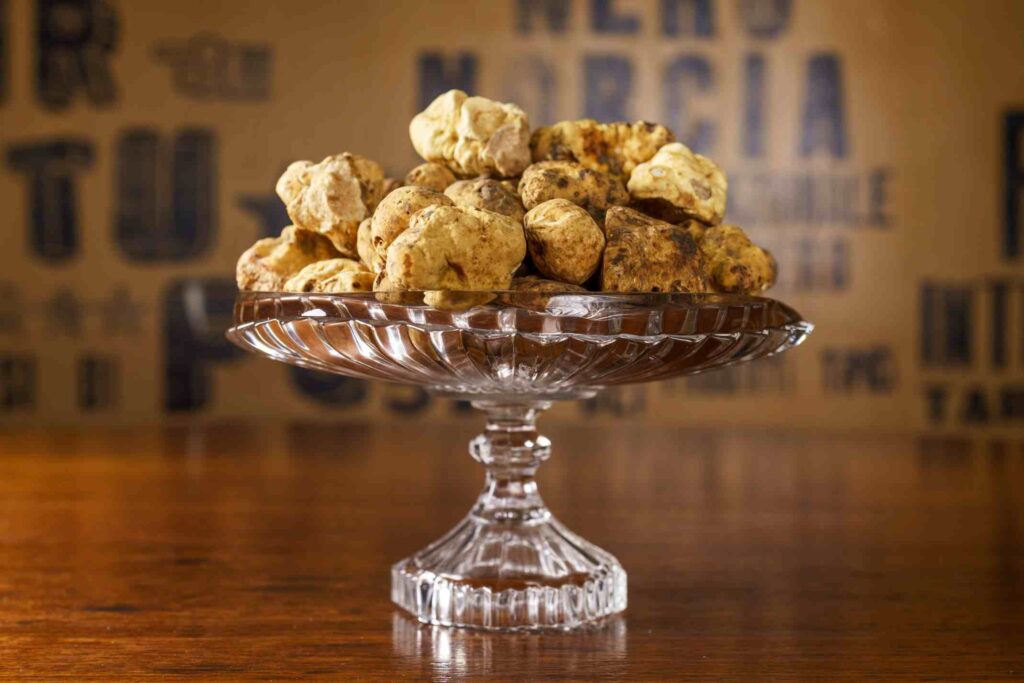
As trufas brancas (Tuber magnatum Pico) são conhecidas mundialmente como a joia mais rara e valorizada da gastronomia. Seu prestígio resulta da combinação entre raridade, dificuldade de obtenção e complexidade sensorial incomparável. O que torna a trufa branca um ingrediente único e admirado em todo o mundo é, antes de tudo, seu perfil aromático. Seu perfume pode remeter a alho fresco, cogumelos, queijos maturados, como Grana Padano, e terra úmida. Na degustação, revela presença marcante, delicadeza e persistência, com nuances que evocam queijo curado, cogumelo e um leve dulçor que recorda o mel. Trata-se de um ingrediente de intensidade aromática singular, marcada por compostos voláteis únicos.
As mais célebres trufas brancas crescem na região de Alba, no Piemonte, e em San Miniato, na Toscana, regiões italianas cujas condições climáticas e geológicas favorecem o desenvolvimento do fungo. Também podem ser encontradas na Emília-Romanha e, fora da Itália, na Ístria (Croácia), na Eslovênia e na Hungria. Cada território imprime nuances distintas ao aroma e ao sabor da trufa.
Autores da Antiguidade já demonstravam fascínio pelo surgimento misterioso das trufas. O filósofo grego Plutarco descreveu que elas se formariam pela combinação de relâmpagos, água e calor da terra, uma tentativa poética de explicar a origem desse fungo subterrâneo, cuja formação permanecia incompreendida naquele período.
Durante o Renascimento, as trufas já figuravam em banquetes aristocráticos nas cortes italianas. Ingrediente raro e ligado à terra e à sazonalidade, era apreciado em preparações refinadas servidas em mesas nobres. Registros culinários do período, como os do cozinheiro Bartolomeo Scappi no século XVI, mostram que as trufas eram valorizadas na gastronomia das cortes e associadas ao prestígio e à sofisticação. No século XVII, as trufas já marcavam presença nas cortes europeias, sendo associadas à sofisticação e ao refinamento da gastronomia aristocrática.
Embora sua história seja mais antiga, foi entre o fim dos anos 1920 e o início dos anos 1930 que a trufa branca de Alba passou a ocupar um lugar de destaque no imaginário gastronômico internacional. Esse movimento foi impulsionado por Giacomo Morra, restaurateur de Alba, que soube promovê-la como expressão maior do território piemontês, a partir da exposição de trufas de 1928, da feira-concurso de 1929 e da consolidação da Fiera del Tartufo em 1933. Além da organização da feira, Morra contribuiu decisivamente para a projeção internacional da trufa branca ao enviar exemplares excepcionais como presente a personalidades políticas e culturais do século XX. Esse gesto ajudou a associar a trufa de Alba a um imaginário de prestígio e exclusividade, consolidando sua reputação global.
O ciclo de vida da trufa branca depende de condições ambientais muito específicas. Ela exige solos calcários bem drenados, ricos em carbonato de cálcio e com pH neutro a levemente alcalino. O terreno deve ser úmido, mas não encharcado, com boa aeração e textura solta. Em muitas áreas produtoras, sua ocorrência está associada a faixas de altitude aproximadas entre 200 e 700 metros acima do nível do mar. O clima deve apresentar estações bem definidas, com verões quentes, mas não excessivos, e invernos frios, condições que favorecem a frutificação.
A trufa branca vive em simbiose micorrízica com raízes de árvores como álamos, avelãs, carvalhos, salgueiros, tílias e carpes. Nesse processo, o fungo amplia a absorção de água e nutrientes minerais pela planta, especialmente fósforo. Em troca, recebe açúcares e outros compostos de carbono produzidos pela fotossíntese da árvore hospedeira. Sua reprodução ocorre por meio da dispersão dos esporos presentes no corpo frutífero, liberados quando a trufa é consumida por animais selvagens ou manipulada no ambiente.
Como fungos subterrâneos, as trufas dependem de animais para dispersar seus esporos. Seu perfume intenso não é apenas uma característica gastronômica, mas também uma estratégia evolutiva. Compostos aromáticos produzidos pelo fungo atraem mamíferos escavadores, que encontram a trufa sob o solo e contribuem para a dispersão de seus esporos na floresta. Esse diálogo químico entre fungos e animais faz da trufa não apenas um ingrediente raro, mas também um exemplo fascinante das interações invisíveis que sustentam os ecossistemas subterrâneos.
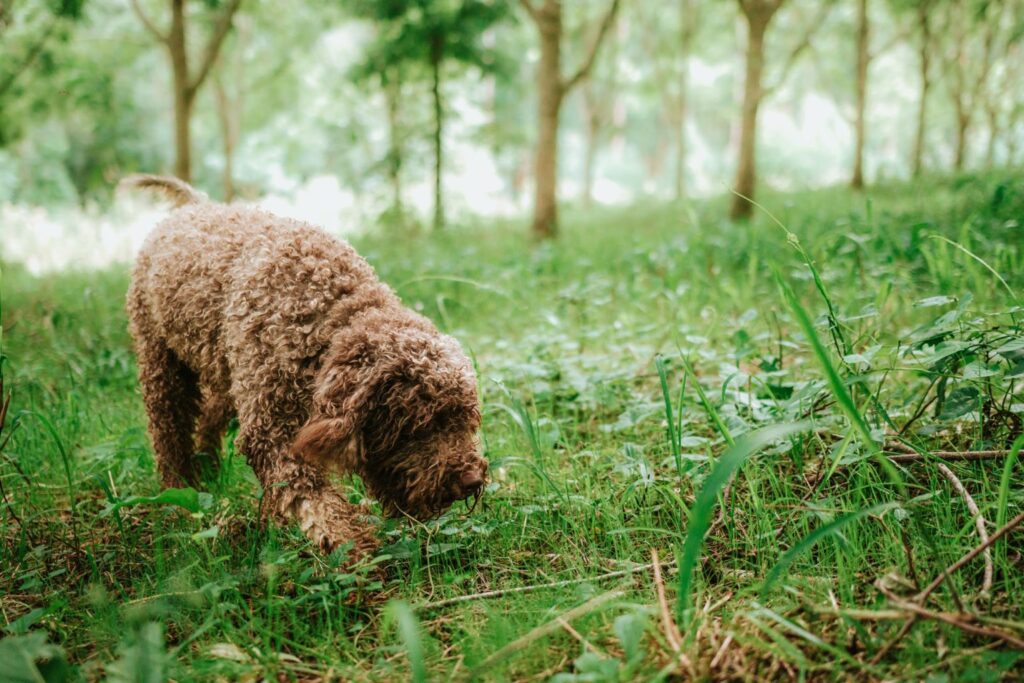
Durante séculos, os porcos foram os principais animais utilizados para encontrar trufas nos bosques europeus. Dotados de um olfato extremamente sensível, eram capazes de detectar o perfume das trufas mesmo quando enterradas profundamente no solo. Porcas fêmeas demonstravam uma atração particular por esse aroma, fato que intrigou caçadores e pesquisadores ao longo da história. Apesar de sua eficiência, os porcos tinham um inconveniente: apreciavam as trufas tanto quanto os humanos. Com o tempo, foram gradualmente substituídos por cães treinados, que permitem uma busca mais controlada e cuidadosa no ambiente natural onde as trufas se desenvolvem.
O período de colheita é restrito e ocorre de outubro a dezembro, podendo estender-se até janeiro em algumas regiões, o que aumenta ainda mais sua exclusividade. O processo de coleta é artesanal, feito com a ajuda de cães treinados, como o Lagotto Romagnolo, que farejam o perfume subterrâneo das trufas. Essa prática secular, conhecida como caccia al tartufo, é parte essencial da cultura italiana e foi reconhecida pela UNESCO como Patrimônio Cultural Imaterial da Humanidade, preservando o saber tradicional transmitido entre gerações de caçadores e suas famílias. A sazonalidade da trufa branca não se resume ao período de colheita. Sua expressão aromática também depende das condições climáticas de cada safra, do equilíbrio hídrico do solo e do grau de maturação de cada exemplar.
Na Itália, a legislação que regula o manuseio, a colheita e a comercialização das trufas é rigorosa. Existem leis específicas que definem os períodos de coleta, restringem o uso de ferramentas que possam danificar o micélio e estabelecem sanções para a colheita ilegal. Diferentemente de outras espécies de trufas, como a negra (Tuber melanosporum), a trufa branca ainda não conta com cultivo comercial estável e amplamente consolidado. Há evidência científica de frutificação em pomar experimental na França, com colheitas em 2019 e 2020, mas os resultados ainda são restritos e tecnicamente desafiadores.
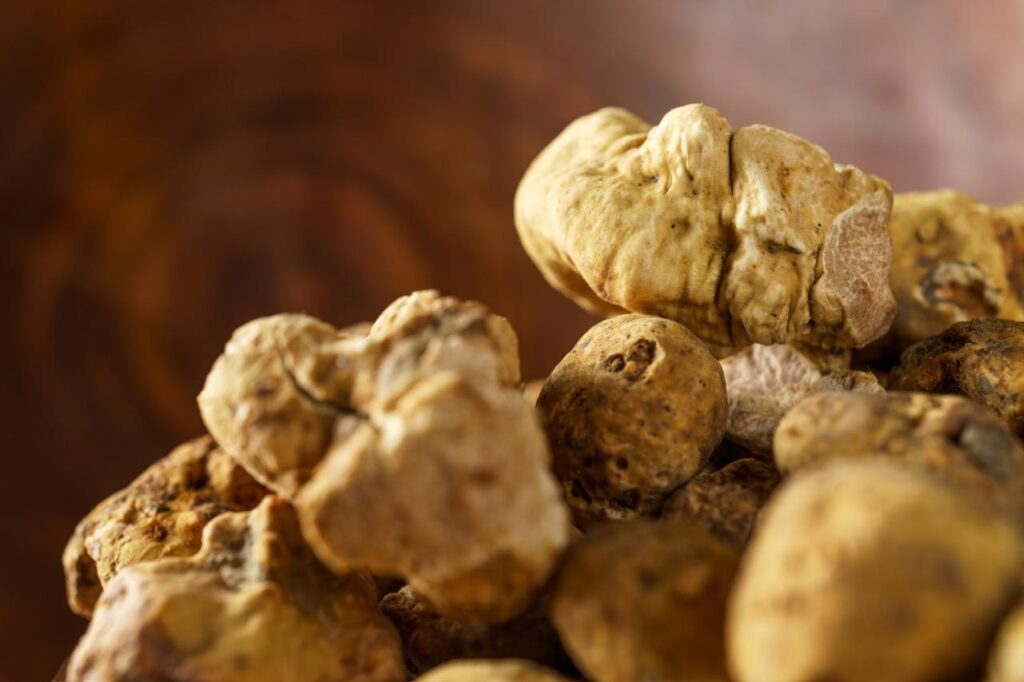
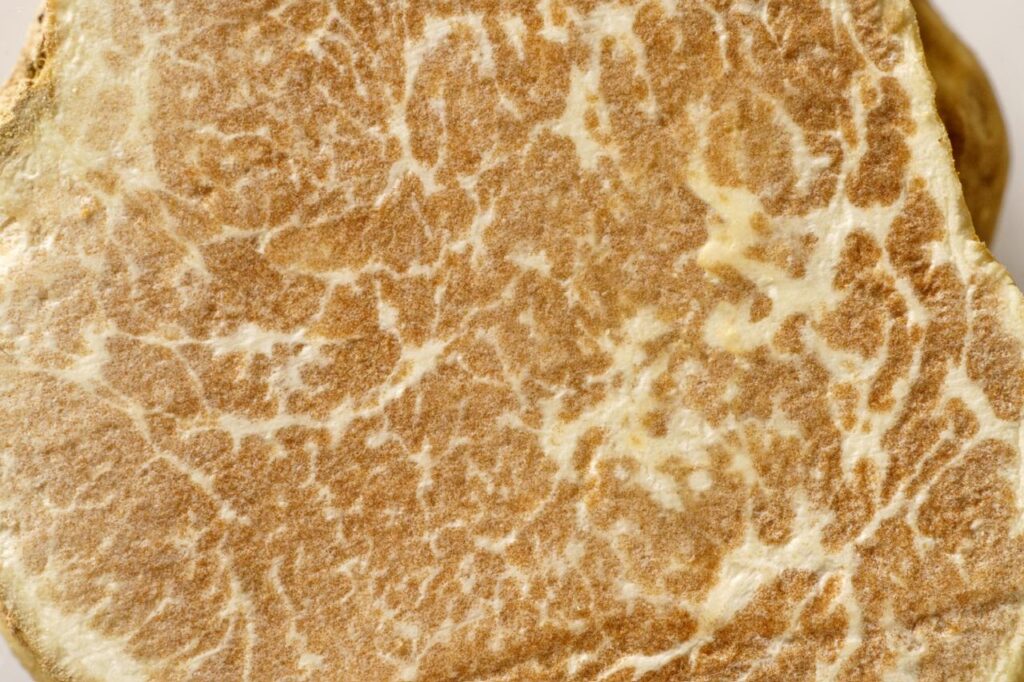
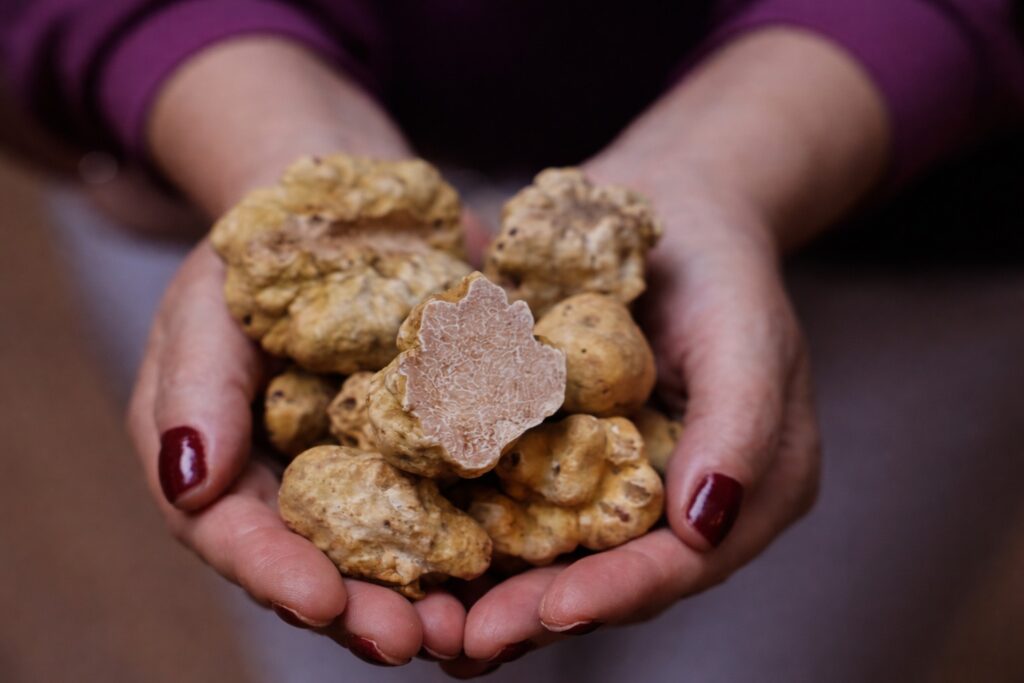
As trufas brancas têm formato bastante irregular, resultado da interação com os terrenos onde se desenvolvem. Apresentam coloração amarelada, variando do creme claro ao ocre. Em média, cada unidade pesa entre 50 g e 300 g, embora existam registros de exemplares excepcionais que ultrapassam 1 kg. O perídio da trufa branca é liso e firme, de aparência aveludada, em tons creme a amarelo-ocre. A gleba revela matizes marfim a avelã, com veios finos e claros que formam o marmoreio característico.
Considerada um verdadeiro diamante da mesa, a trufa branca é disputada em leilões internacionais e alcança preços altíssimos. O mais comum é que os exemplares permaneçam bem abaixo de 1 kg, frequentemente chegando até cerca de 500 g. Devido à raridade e à complexidade aromática, pode alcançar muitos milhares de euros por quilo, variando amplamente conforme a safra, o tamanho e a qualidade. Existem achados excepcionais. Em 2 de novembro de 1999, Giancarlo Zigante e sua cadela Diana encontraram uma trufa branca de 1,31 kg na região de Buje, na Ístria, exemplar associado a registro no Guinness Book of Records. A trufa branca pode atingir dimensões raríssimas, como ocorreu em 23 de novembro de 2007, quando um exemplar de cerca de 1,5 kg foi encontrado em Palaia, na província de Pisa, Toscana. Em 1º de dezembro do mesmo ano, a peça foi arrematada por US$ 330.000 em um leilão beneficente internacional, tornando-se um dos casos mais emblemáticos da história recente da trufa branca. Em novembro de 2021, no Alba White Truffle World Auction, realizado em Grinzane Cavour, um exemplar excepcional de 830 g foi arrematado por € 103.000.
Do ponto de vista químico, as trufas brancas apresentam uma combinação complexa de compostos voláteis responsáveis por seu perfil aromático. Entre eles destacam-se compostos sulfurados, como dimetil sulfeto e metanotiol, além do 2,4-dithiapentane, frequentemente citado na literatura científica como um dos principais marcadores aromáticos da Tuber magnatum. Também estão presentes álcoois, como o 1-octen-3-ol, além de aldeídos, cetonas e ácidos graxos voláteis. Essa combinação ajuda a explicar a singularidade do aroma da trufa branca, capaz de revelar simultaneamente notas terrosas, sulfúricas, amanteigadas e levemente adocicadas.
Mesmo entre trufas colhidas na mesma região e na mesma safra, a intensidade aromática pode variar consideravelmente entre exemplares. Essa diferença está relacionada ao grau de maturação do corpo frutífero, às condições específicas do solo e também à microbiota associada ao fungo. Estudos recentes indicam que bactérias presentes na superfície e no interior da trufa participam da transformação de compostos químicos ligados ao seu perfume característico. Por isso, cada trufa revela uma expressão aromática própria, resultado da interação entre maturação, ambiente e território.
Após a colheita, a trufa branca continua sendo um organismo vivo e pode apresentar uma breve revelação aromática fora do solo. Processos enzimáticos ainda ativos no fungo transformam precursores químicos em compostos voláteis responsáveis por seu perfume característico. Por essa razão, caçadores de trufas e chefs frequentemente observam que o aroma da Tuber magnatum parece se revelar gradualmente após ser retirada da terra. Ainda assim, trata-se de um ingrediente altamente perecível com durabilidade de até 10 dias sendo bem conservada.
A intensidade aromática da trufa branca está diretamente relacionada à volatilidade de seus compostos aromáticos. Muitos desses compostos são altamente sensíveis ao calor e se dissipam rapidamente quando submetidos a temperaturas elevadas. Por essa razão, a Tuber magnatum raramente é cozida. A prática tradicional consiste em laminá-la fresca diretamente sobre o prato pronto, aproveitando apenas o calor residual da preparação para liberar seus aromas sem degradar suas moléculas mais delicadas.
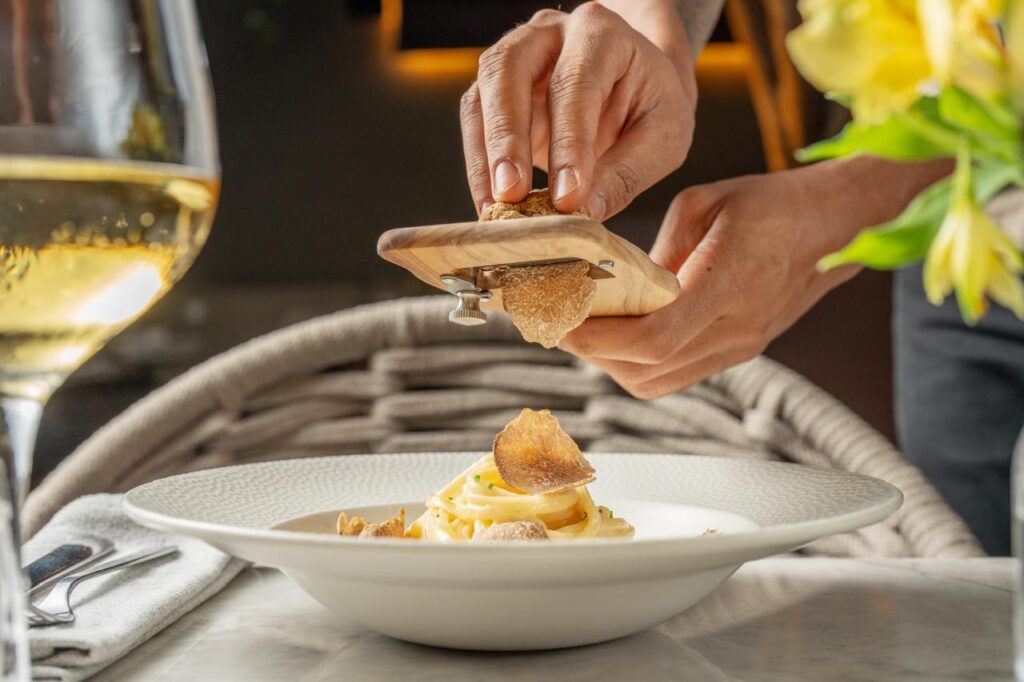
Na gastronomia, a trufa branca é tradicionalmente apreciada crua, laminada finamente no momento do serviço sobre preparações quentes e delicadas. Massas frescas, risotos e ovos figuram entre as combinações mais consagradas porque oferecem uma base neutra e acolhedora para que seu perfume se revele com plenitude. Mesmo respeitando a tradição italiana, alguns chefs contemporâneos têm explorado novos territórios gastronômicos para a trufa branca, como combinações com frutos do mar, preparações com arroz no estilo japonês e bases lácteas utilizadas em sobremesas sazonais. O princípio, porém, permanece o mesmo: a Tuber magnatum não é cozida, mas laminada fresca no momento do serviço, aproveitando apenas o calor residual do prato para liberar seus compostos aromáticos voláteis.
A clássica combinação entre ovos e trufas não se deve apenas à tradição culinária italiana. Existe também uma afinidade sensorial entre esses ingredientes. A trufa branca possui compostos aromáticos sulfurados semelhantes aos naturalmente presentes nos ovos, especialmente na gema. Além disso, a riqueza de lipídios da gema funciona como um meio ideal para difundir e amplificar moléculas aromáticas voláteis. Por isso, preparações simples como ovos fritos, pochê ou mexidos tornaram-se, ao longo da história, uma das formas mais puras de apreciar o perfume da trufa fresca.
A manteiga é um dos suportes mais clássicos para a trufa branca. Isso não ocorre apenas por tradição culinária, mas também por afinidade química. Os principais compostos aromáticos da trufa são lipossolúveis, o que significa que se difundem com facilidade em meios gordurosos. A manteiga, rica em lipídios e de sabor delicado, funciona como um veículo que captura e distribui essas moléculas aromáticas, permitindo que o perfume da trufa se espalhe pelo prato. Quando utilizada em temperatura morna, ela libera gradualmente esses aromas, ampliando a experiência sensorial sem competir com a delicadeza da trufa.
Queijos de longa maturação, como Parmigiano Reggiano e Grana Padano, também apresentam uma afinidade natural com as trufas. Durante o processo de maturação, esses queijos desenvolvem elevadas concentrações de glutamato natural, responsável pela percepção do umami. Esse elemento gustativo intensifica a experiência sensorial do prato sem competir com o perfume da trufa. Além disso, a presença de gordura no queijo contribui para difundir e prolongar os compostos aromáticos voláteis da trufa, criando uma combinação que a culinária italiana consagrou ao longo dos séculos.
Massas frescas também se tornaram um dos suportes clássicos para a trufa branca na culinária italiana. Sua superfície quente e delicada permite que os compostos aromáticos voláteis da trufa se liberem gradualmente quando laminados sobre o prato. Ao mesmo tempo, a presença de manteiga ou azeite cria uma fase gordurosa que ajuda a difundir esses aromas pela massa. A neutralidade gustativa da massa fresca preserva o protagonismo da trufa, transformando preparações simples, como tajarin ou tagliolini com manteiga, em uma das expressões mais puras da gastronomia das trufas.
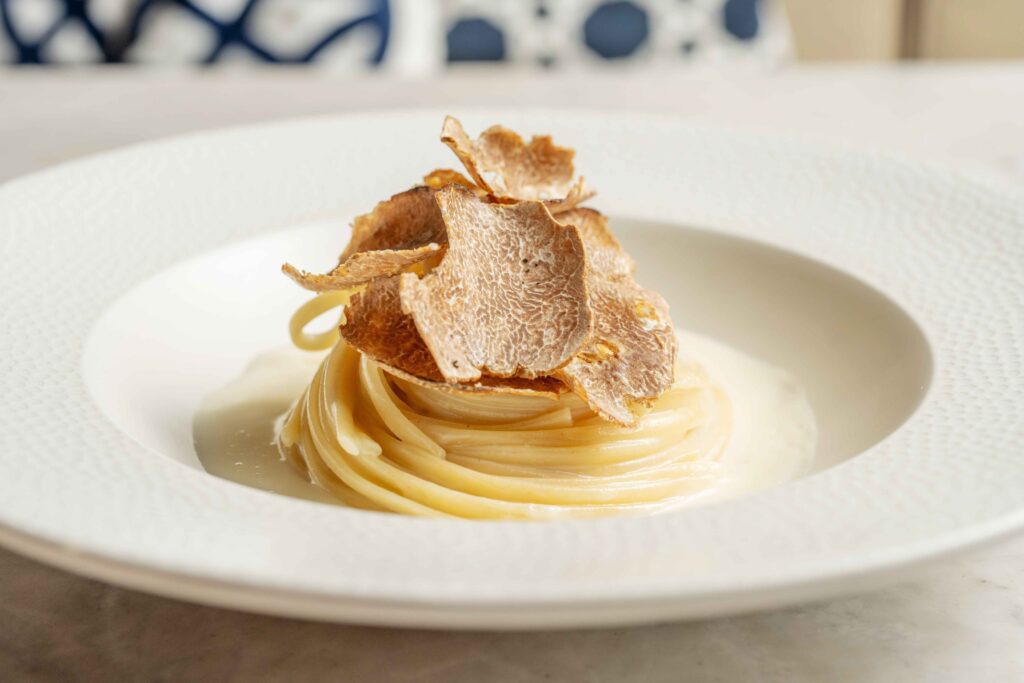
Na tradição gastronômica do Piemonte, território clássico da trufa branca, muitos cozinheiros mencionam o princípio da cucina per sottrazione, ou “cozinha por subtração”. A ideia é simples: quando um ingrediente possui grande complexidade aromática, o melhor caminho não é acrescentar elementos, mas retirar tudo o que é desnecessário. Assim, pratos preparados com trufa branca costumam ter poucos componentes, escolhidos apenas para sustentar sua expressão aromática. Massas frescas com manteiga, ovos ou risotos delicados tornam-se, dessa forma, uma base discreta que permite que o perfume da trufa se revele plenamente.
Por serem extremamente delicadas, as trufas brancas devem ser consumidas rapidamente após a colheita. Antes do consumo, recomenda-se higienizá-las cuidadosamente com uma escovinha macia ou pincel de cerdas finas, retirando os resíduos de terra e, se necessário, apenas umedecendo levemente a escova, para não comprometer sua estrutura e seu aroma. A melhor forma de armazená-las é embrulhadas em papel-toalha, que deve ser trocado diariamente, dentro de um recipiente fechado na área mais fria da geladeira. Como curiosidade gastronômica, ovos e arroz podem absorver parte de seu perfume, mas isso não substitui os cuidados centrais de conservação. Mesmo com todos os cuidados, sua durabilidade não costuma ultrapassar 7 a 10 dias.
As trufas brancas representam a união entre natureza, ciência e cultura. São efêmeras e inimitáveis, carregando em cada exemplar a história do solo e da floresta em que nasceram. Degustá-las é participar de uma experiência sensorial única e de uma tradição gastronômica milenar que continua encantando chefs e apreciadores em todo o mundo.
Além de suas características científicas e gastronômicas, é a aura de raridade, exclusividade e fascínio que eterniza a trufa branca. Sua safra imprevisível, o consumo imediato e a ausência, até hoje, de um cultivo comercial estável e amplamente consolidado reforçam seu caráter efêmero e excepcional. Carregada de mitos desde a Antiguidade, associada a rituais, poderes afrodisíacos e banquetes reais, a trufa branca não é apenas um ingrediente: é território, tempo e cultura gastronômica. Provar uma trufa branca fresca é viver um momento irrepetível, guardado para sempre na memória de quem a degusta.
Monica Maia Claro | Trufas
Monica Maia Claro é especialista em trufas e cofundadora da Tartuferia San Paolo. Engenheira química pela Escola de Engenharia Mauá, com pós-graduação em Administração e Marketing pela FGV-SP e Executive MBA pela FEA-USP, atua há mais de uma década na construção da cultura das trufas no Brasil, unindo repertório técnico, curadoria gastronômica e experiência à mesa.
À frente da Tartuferia, Monica se destacou por ampliar o acesso a trufas frescas sazonais e por desenvolver uma linha de produtos com trufas baseada em processos de incorporação e critérios sensoriais rigorosos. Também participa de iniciativas de pesquisa e cultivo, contribuindo para que o tema trufas ganhe território, linguagem e consistência no país.
White Truffle: Time, Territory and Revelation
Tartufo Bianco (Tuber magnatum Pico)
Sublime. Unique. Enchanting.
Monica Maia Claro, truffle specialist and founder of Tartuferia San Paolo
March 10, 2026
White Truffle (Tuber magnatum Pico)
White truffles (Tuber magnatum Pico) are known worldwide as the rarest and most highly prized jewel of gastronomy. Their prestige results from the combination of rarity, difficulty of obtaining them, and incomparable sensory complexity. What makes the white truffle a unique and admired ingredient around the world is, above all, its aromatic profile. Its perfume may evoke fresh garlic, mushrooms, aged cheeses such as Grana Padano, and damp earth. On the palate, it reveals marked presence, delicacy, and persistence, with nuances that recall cured cheese, mushroom, and a slight sweetness reminiscent of honey. It is an ingredient of singular aromatic intensity, defined by unique volatile compounds.
The most celebrated white truffles grow in the region of Alba, in Piedmont, and in San Miniato, in Tuscany, Italian regions whose climatic and geological conditions favor the development of the fungus. They can also be found in Emilia-Romagna and, outside Italy, in Istria (Croatia), Slovenia, and Hungary. Each territory imprints distinct nuances on the truffle’s aroma and flavor.
Authors of Antiquity were already fascinated by the mysterious appearance of truffles. The Greek philosopher Plutarch described them as being formed by the combination of lightning, water, and the heat of the earth, a poetic attempt to explain the origin of this subterranean fungus, whose formation remained poorly understood in that period.
During the Renaissance, truffles already appeared at aristocratic banquets in the Italian courts. A rare ingredient linked to the earth and to seasonality, they were appreciated in refined preparations served on noble tables. Culinary records from the period, such as those of the cook Bartolomeo Scappi in the sixteenth century, show that truffles were valued in court gastronomy and associated with prestige and sophistication. By the seventeenth century, truffles were already present in European courts, associated with the refinement of aristocratic gastronomy.
Although their history is older, it was between the late 1920s and the early 1930s that the white truffle of Alba came to occupy a place of prominence in the international gastronomic imagination. This movement was driven by Giacomo Morra, a restaurateur from Alba, who knew how to promote it as the highest expression of the Piedmontese territory, beginning with the truffle exhibition of 1928, the fair-competition of 1929, and the consolidation of the Fiera del Tartufo in 1933. In addition to organizing the fair, Morra contributed decisively to the white truffle’s international projection by sending exceptional specimens as gifts to political and cultural personalities of the twentieth century. This gesture helped associate the truffle of Alba with an image of prestige and exclusivity, consolidating its global reputation.
The life cycle of the white truffle depends on very specific environmental conditions. It requires well-drained calcareous soils, rich in calcium carbonate and with a neutral to slightly alkaline pH. The ground must be moist but not waterlogged, with good aeration and a loose texture. In many producing areas, its occurrence is associated with approximate elevations between 200 and 700 meters above sea level. The climate must have well-defined seasons, with warm but not excessive summers and cold winters, conditions that favor fruiting.
The white truffle lives in ectomycorrhizal symbiosis with the roots of trees such as poplars, hazelnuts, oaks, willows, lindens, and hornbeams. In this process, the fungus enhances the plant’s absorption of water and mineral nutrients, especially phosphorus. In exchange, it receives sugars and other carbon compounds produced by the host tree through photosynthesis. Its reproduction occurs through the dispersal of spores present in the fruiting body, released when the truffle is consumed by wild animals or disturbed in the environment.
As subterranean fungi, truffles depend on animals to disperse their spores. Their intense perfume is not only a gastronomic characteristic, but also an evolutionary strategy. Aromatic compounds produced by the fungus attract digging mammals, which find the truffle beneath the soil and contribute to the dispersal of its spores in the forest. This chemical dialogue between fungi and animals makes the truffle not only a rare ingredient, but also a fascinating example of the invisible interactions that sustain subterranean ecosystems.
For centuries, pigs were the main animals used to find truffles in European woodlands. Endowed with an extremely sensitive sense of smell, they were able to detect the perfume of truffles even when they were deeply buried in the soil. Female pigs showed a particular attraction to this aroma, a fact that intrigued hunters and researchers throughout history. Despite their efficiency, pigs had one inconvenience: they appreciated truffles as much as humans did. Over time, they were gradually replaced by trained dogs, which allow for a more controlled and careful search in the natural environment where truffles develop.
The harvesting period is limited and takes place from October to December, extending into January in some regions, which further increases its exclusivity. The collection process is artisanal and carried out with the help of trained dogs, such as the Lagotto Romagnolo, which detect the underground perfume of truffles. This secular practice, known as caccia al tartufo, is an essential part of Italian culture and was recognized by UNESCO as Intangible Cultural Heritage of Humanity, preserving traditional knowledge passed down among generations of hunters and their families. The seasonality of the white truffle is not limited to the harvesting period. Its aromatic expression also depends on the climatic conditions of each season, the hydric balance of the soil, and the degree of maturation of each specimen.
In Italy, the legislation governing the handling, harvesting, and commercialization of truffles is strict. Specific laws define harvesting periods, restrict the use of tools that may damage the mycelium, and establish sanctions for illegal harvesting. Unlike other truffle species, such as the black truffle (Tuber melanosporum), the white truffle still does not have stable and widely consolidated commercial cultivation. There is scientific evidence of fruiting in an experimental orchard in France, with harvests in 2019 and 2020, but the results remain limited and technically challenging.
White truffles have a highly irregular shape, resulting from their interaction with the soils in which they develop. They display a yellowish coloration, ranging from pale cream to ochre. On average, each truffle weighs between 50 g and 300 g, although there are records of exceptional specimens exceeding 1 kg. The peridium of the white truffle is smooth and firm, with a velvety appearance in cream to yellow-ochre tones. The gleba reveals shades from ivory to hazelnut, crossed by fine pale veins that create the characteristic marbling.
Considered a true diamond of the table, the white truffle is disputed at international auctions and reaches extraordinary prices. Most specimens remain well below 1 kg, often reaching only about 500 g. Because of its rarity and aromatic complexity, it can command many thousands of euros per kilogram, varying widely according to the season, size, and quality. There are exceptional finds. On November 2, 1999, Giancarlo Zigante and his dog Diana found a white truffle weighing 1.31 kg in the region of Buje, in Istria, a specimen associated with a Guinness Book of Records entry. The white truffle can reach extremely rare dimensions, as happened on November 23, 2007, when a specimen of around 1.5 kg was found in Palaia, in the province of Pisa, Tuscany. On December 1 of that same year, the piece was sold for US$ 330,000 at an international charity auction, becoming one of the most emblematic cases in the recent history of the white truffle. In November 2021, at the Alba White Truffle World Auction held in Grinzane Cavour, an exceptional specimen weighing 830 g was sold for EUR 103,000.
From a chemical point of view, white truffles display a complex combination of volatile compounds responsible for their aromatic profile. Among them, sulfur compounds stand out, such as dimethyl sulfide and methanethiol, as well as 2,4-dithiapentane, frequently cited in the scientific literature as one of the principal aromatic markers of Tuber magnatum. Alcohols such as 1-octen-3-ol are also present, along with aldehydes, ketones, and volatile fatty acids. This combination helps explain the singularity of the white truffle’s aroma, capable of simultaneously revealing earthy, sulfurous, buttery, and slightly sweet notes.
Even among truffles harvested in the same region and in the same season, aromatic intensity can vary considerably from one specimen to another. This difference is related to the degree of maturation of the fruiting body, to the specific soil conditions, and also to the microbiota associated with the fungus. Recent studies indicate that bacteria present on the surface and inside the truffle participate in the transformation of chemical compounds linked to its characteristic perfume. For this reason, each truffle reveals its own aromatic expression, resulting from the interaction between maturation, environment, and territory.
After harvesting, the white truffle remains a living organism and may undergo a brief aromatic revelation outside the soil. Enzymatic processes still active in the fungus transform chemical precursors into volatile compounds responsible for its characteristic perfume. For this reason, truffle hunters and chefs often observe that the aroma of Tuber magnatum seems to reveal itself gradually after it is removed from the earth. Even so, it is a highly perishable ingredient with a shelf life of up to 10 days when well preserved.
The aromatic intensity of the white truffle is directly related to the volatility of its aromatic compounds. Many of these compounds are highly sensitive to heat and dissipate quickly when subjected to elevated temperatures. For this reason, Tuber magnatum is rarely cooked. Traditional practice consists of shaving it fresh directly over the finished dish, using only the residual heat of the preparation to release its aromas without degrading its most delicate molecules.
In gastronomy, the white truffle is traditionally appreciated raw, shaved finely at the moment of service over warm and delicate preparations. Fresh pasta, risotto, and eggs are among its most celebrated pairings because they offer a neutral and receptive base that allows its perfume to reveal itself fully. Even while respecting Italian tradition, some contemporary chefs have explored new gastronomic territories for the white truffle, such as pairings with seafood, rice preparations in a Japanese style, and dairy bases used in seasonal desserts. The principle, however, remains the same: Tuber magnatum is not cooked, but shaved fresh at the moment of service, taking advantage only of the residual heat of the dish to release its volatile aromatic compounds.
The classic combination of eggs and truffles is not due only to Italian culinary tradition. There is also a sensory affinity between these ingredients. The white truffle contains sulfur compounds similar to those naturally present in eggs, especially in the yolk. In addition, the lipid richness of the yolk functions as an ideal medium for diffusing and amplifying volatile aromatic molecules. For this reason, simple preparations such as fried, poached, or scrambled eggs have become, throughout history, one of the purest ways to appreciate the perfume of fresh truffle.
Butter is one of the most classic supports for the white truffle. This is not only a matter of culinary tradition, but also of chemical affinity. The principal aromatic compounds of truffles are liposoluble, which means they diffuse easily in fatty media. Butter, rich in lipids and delicate in flavor, works as a vehicle that captures and distributes these aromatic molecules, allowing the truffle’s perfume to spread through the dish. When used at a warm temperature, it gradually releases these aromas, amplifying the sensory experience without competing with the truffle’s delicacy.
Long-aged cheeses such as Parmigiano Reggiano and Grana Padano also have a natural affinity with truffles. During the maturation process, these cheeses develop high concentrations of natural glutamate, responsible for the perception of umami. This gustatory element intensifies the sensory experience of the dish without competing with the truffle’s perfume. In addition, the fat present in the cheese helps diffuse and prolong the truffle’s volatile aromatic compounds, creating a combination that Italian cuisine has consecrated over the centuries.
Fresh pasta has likewise become one of the classic supports for the white truffle in Italian cuisine. Its warm and delicate surface allows the truffle’s volatile aromatic compounds to be released gradually when shaved over the dish. At the same time, the presence of butter or olive oil creates a fatty phase that helps diffuse these aromas through the pasta. The gustatory neutrality of fresh pasta preserves the truffle’s protagonism, transforming simple preparations, such as tajarin or tagliolini with butter, into one of the purest expressions of truffle gastronomy.
In the gastronomic tradition of Piedmont, the classic territory of the white truffle, many cooks refer to the principle of cucina per sottrazione, or “cooking by subtraction.” The idea is simple: when an ingredient possesses great aromatic complexity, the best path is not to add elements, but to remove everything that is unnecessary. Thus, dishes prepared with white truffle usually have few components, chosen only to support its aromatic expression. Fresh pasta with butter, eggs, or delicate risottos become, in this way, a discreet base that allows the truffle’s perfume to reveal itself fully.
Because they are extremely delicate, white truffles must be consumed quickly after harvesting. Before consumption, they should be cleaned carefully with a soft brush or a fine-bristled brush, removing traces of soil and, if necessary, only lightly moistening the brush so as not to compromise their structure and aroma. The best way to store them is wrapped in paper towel, which should be changed daily, inside a closed container in the coldest part of the refrigerator. As a gastronomic curiosity, eggs and rice can absorb part of their perfume, but this does not replace the central practices of preservation. Even with all precautions, their shelf life usually does not exceed 7 to 10 days.
White truffles represent the union of nature, science, and culture. They are ephemeral and inimitable, carrying in each specimen the history of the soil and the forest in which they were born. To taste them is to participate in a unique sensory experience and in a millenary gastronomic tradition that continues to enchant chefs and enthusiasts all over the world.
Beyond their scientific and gastronomic characteristics, it is the aura of rarity, exclusivity, and fascination that eternalizes the white truffle. Its unpredictable season, immediate consumption, and the absence, to this day, of stable and widely consolidated commercial cultivation reinforce its ephemeral and exceptional character. Loaded with myths since Antiquity, associated with rituals, aphrodisiac powers, and royal banquets, the white truffle is not merely an ingredient: it is territory, time, and gastronomic culture. To taste a fresh white truffle is to live an unrepeatable moment, kept forever in the memory of the one who tastes it.
Monica Maia Claro | Truffles
About the author
Monica Maia Claro is a truffle specialist and co-founder of Tartuferia San Paolo. A chemical engineer from Mauá School of Engineering, with postgraduate studies in Administration and Marketing from FGV-SP and an Executive MBA from FEA-USP, she has worked for more than a decade to build truffle culture in Brazil, combining technical knowledge, gastronomic curation, and experience at the table.
At the head of Tartuferia, Monica has distinguished herself by expanding access to seasonal fresh truffles and by developing a line of truffle products based on incorporation processes and rigorous sensory criteria. She also participates in research and cultivation initiatives, helping the subject of truffles gain territory, language, and consistency in the country.