Tartufo Nero Estivo (Tuber aestivum Vittadini)
Solar. Delicada. Versátil.
26 de Março de 2026
Trufa Negra de Verão (Tuber aestivum Vittadini)
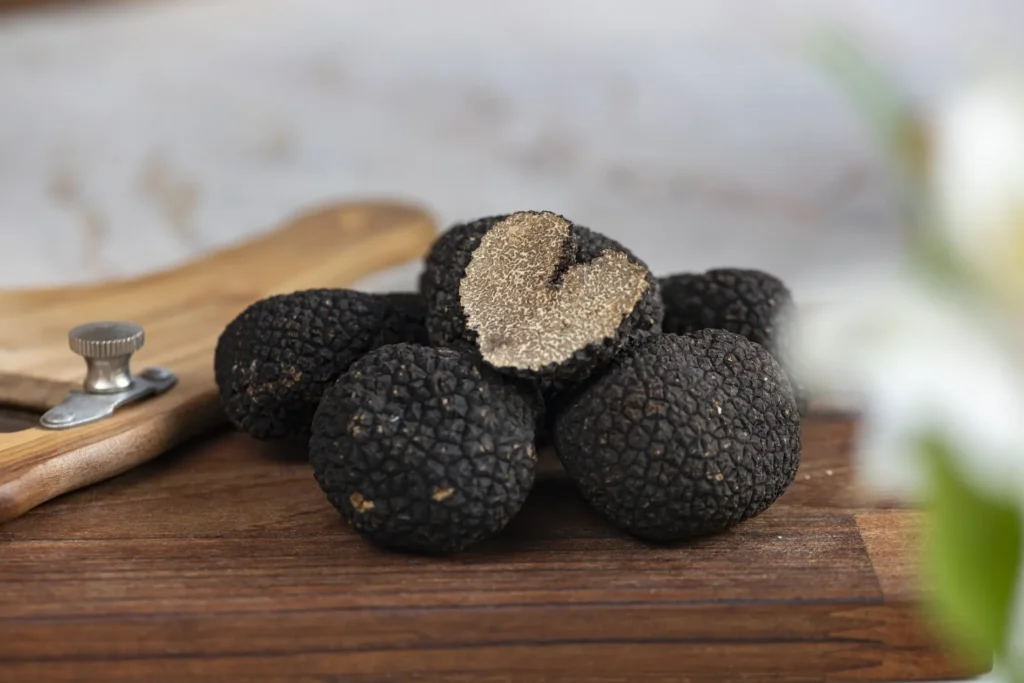
Conhecida na Itália como Tartufo Estivo ou Scorzone, a Trufa Negra de Verão é a expressão solar do universo das trufas. Seu perídio escuro, espesso e rugoso explica o apelido Scorzone, ligado à ideia de casca dura. Rústica, generosa e extremamente versátil, ela oferece um caminho de entrada para o mundo das trufas frescas. Seu perfume é delicado e elegante, com notas de funghi fresco, avelãs, malte e grãos tostados, evocando a floresta em pleno verão. Embora menos intensa que a Trufa Negra de Verão, é a espécie mais difundida da Europa e uma das mais acolhedoras à mesa.
A Tuber aestivum está amplamente distribuída na Itália, sobretudo na Úmbria, Toscana, Marche, Abruzzo, Emilia-Romagna e Piemonte. Também ocorre na França, Espanha, Croácia, Hungria e Eslovênia, com presença importante nos mercados da Inglaterra e dos Bálcãs. Entre os terroirs mais valorizados estão os bosques de carvalhos e aveleiras das colinas da Úmbria e da Toscana, onde o clima quente e úmido favorece a maturação e a expressão aromática da espécie.
Como fungo ectomicorrízico, a Trufa Negra de Verão vive em associação com as raízes de carvalhos como Quercus robur, Quercus cerris e Quercus pubescens, além de avelãs, Corylus avellana, e pinheiros como Pinus nigra e Pinus pinea. Prefere solos calcários, bem drenados, de textura arenosa, pH alcalino, boa exposição solar e altitudes médias entre 200 e 800 metros. Sua resistência e capacidade de adaptação explicam por que se tornou uma das espécies mais presentes na truficultura moderna, inclusive fora da Europa.
A colheita ocorre de maio a setembro, quando o solo atinge condições térmicas favoráveis à frutificação e ao desenvolvimento do perfume característico. A caça é feita com cães treinados, especialmente o Lagotto Romagnolo, muitas vezes ao amanhecer, quando o aroma subterrâneo se torna mais perceptível. Por amadurecer em pleno verão, sua coleta carrega um simbolismo próprio. É uma colheita de luz, perfume e sabor.
A Trufa Estivo revela um perfil sensorial delicado e equilibrado. No aroma, apresenta notas de funghi fresco, terra úmida e avelã, com nuances sutis de bosque, cereal e leve tostado. No paladar, confirma essa elegância com sabor suave, limpo e harmonioso, em que reaparecem o cogumelo fresco e a avelã, acompanhados por discreto dulçor natural e um final sereno, de fruto seco e sub-bosque. Em vez de dominar o prato, envolve-o com sutileza.
Sua expressão aromática, porém, não é absolutamente fixa. Como ocorre com outras trufas, varia conforme o grau de maturação, a origem geográfica, o ambiente de crescimento e as condições de conservação após a colheita. É justamente essa combinação entre espécie, território e tempo que explica por que algumas Estivo se mostram mais funginas e aveludadas, enquanto outras revelam traços mais nítidos de fruto seco, cereal e sub-bosque.
Essa suavidade explica sua grande vocação culinária. A Trufa Negra de Verão é ideal para introduzir novos apreciadores ao universo das trufas frescas, justamente porque permite compreensão aromática sem saturação. Em geral, trabalha muito bem em quantidades de 3 a 8 gramas por pessoa, laminada finamente ou ralada sobre o prato pronto. Ovos, massas, risotos, batatas, carnes brancas e queijos suaves são suportes particularmente adequados para a espécie.
Há também uma lógica sensorial e físico-química nessa afinidade. Preparações quentes e delicadamente gordurosas funcionam como suporte para a difusão dos compostos voláteis, ampliando a percepção aromática sem encobrir a delicadeza da espécie. Por isso, ovo, manteiga, azeite leve e laticínios suaves favorecem sua expressão no prato.
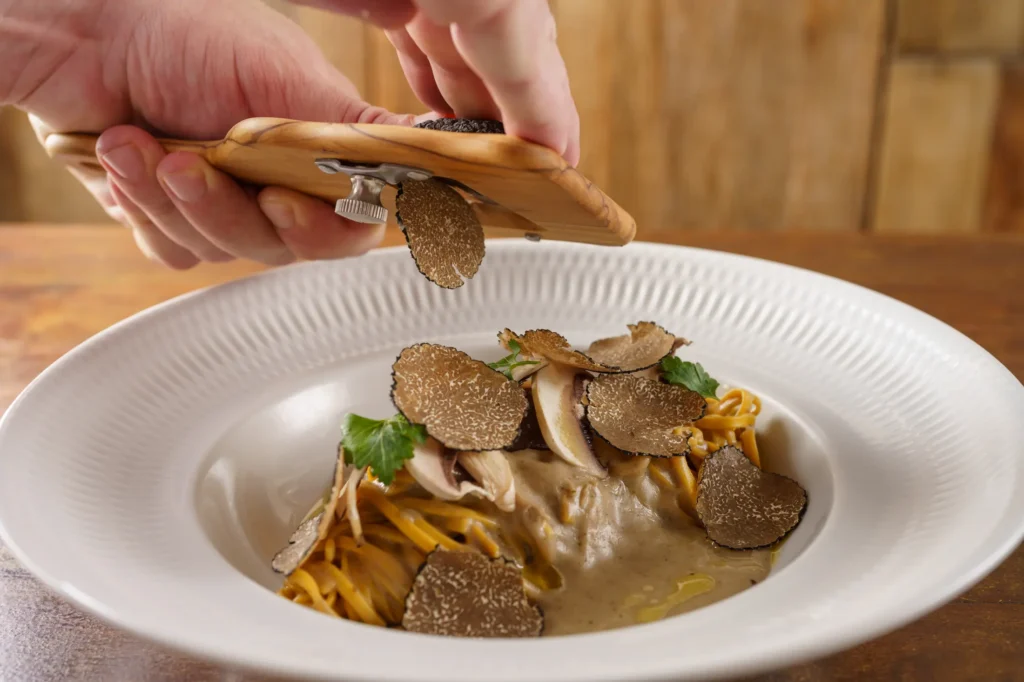
Na tradição italiana, alguns pratos expressam com clareza essa afinidade. Tagliolini al burro e Scorzone, Uova al tegamino con tartufo estivo e Risotto ai funghi e tartufo nero estivo são exemplos clássicos de preparações em que a trufa encontra espaço para se revelar sem excessos.
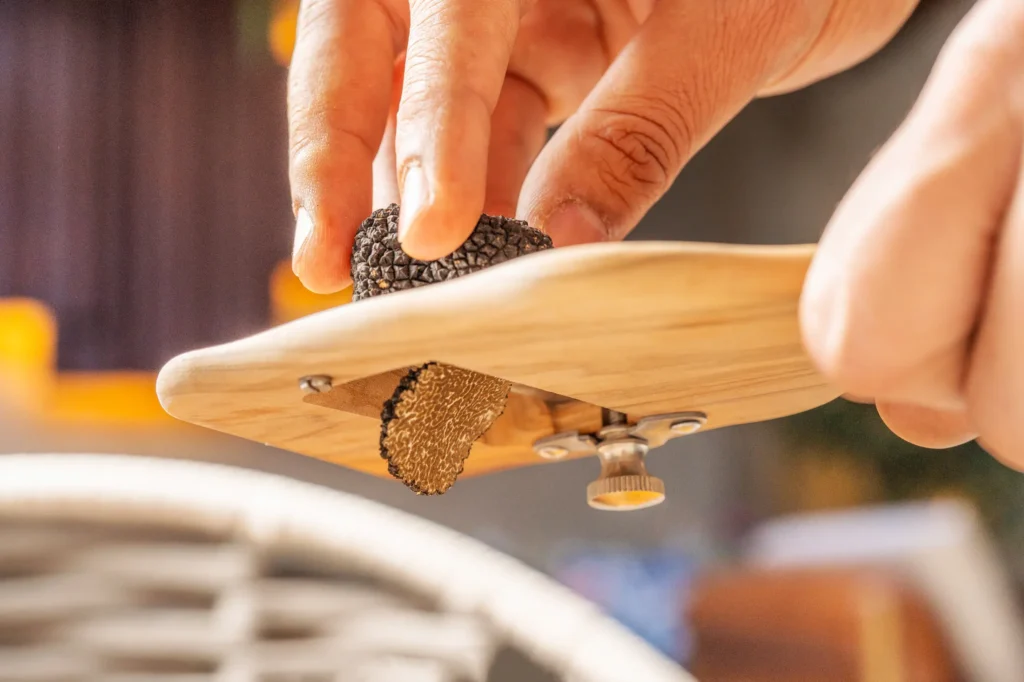
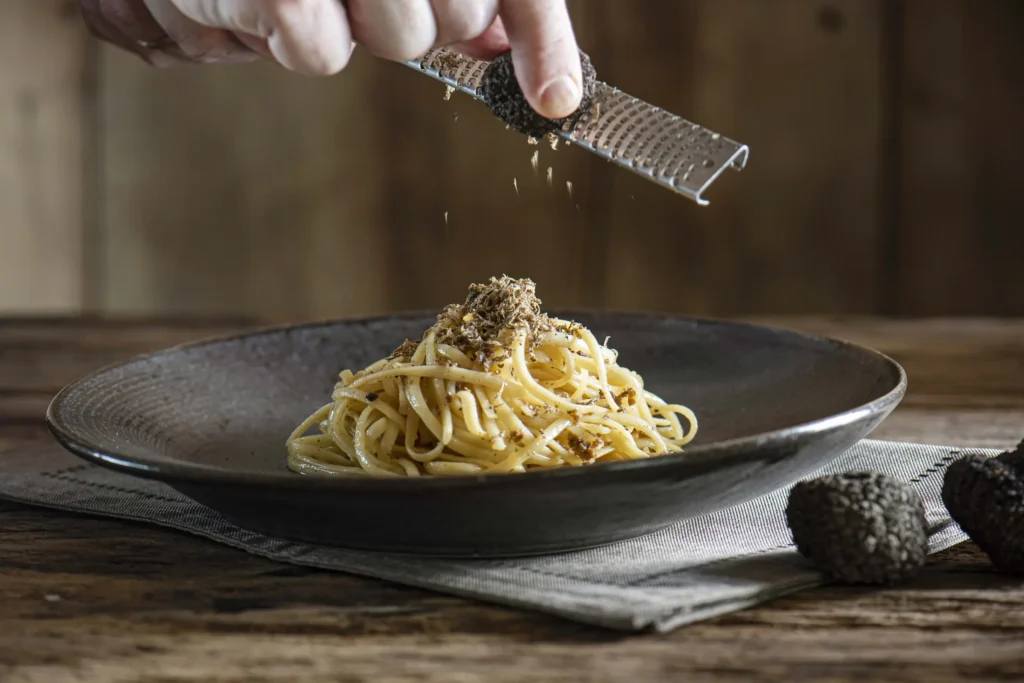
A forma de aplicação também altera a experiência. Quando laminada, a Trufa Negra de Verão se apresenta em lâminas visíveis, que chegam primeiro pelo olhar e liberam o aroma de modo mais gradual sobre o calor do prato. Já ralada, distribui-se com maior uniformidade, envolvendo a preparação e criando uma percepção aromática mais difusa e contínua. Não se trata de hierarquia, mas de efeito: a laminação valoriza presença, gesto e textura; o ralado favorece integração e espalhamento do perfume no conjunto.
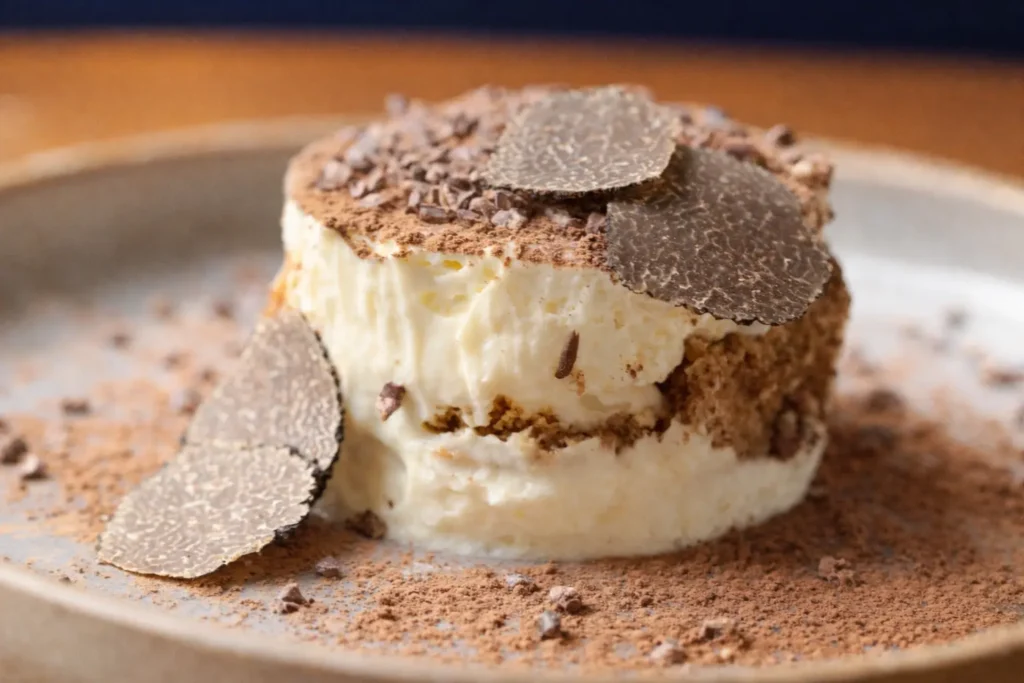
Embora menos comum, a laminação de trufas em sobremesas também pode ser muito bem sucedida, sobretudo com as trufas negras, cujas notas podem se aproximar de avelã, manteiga, cacau suave e terra seca. Em sobremesas de doçura contida e base cremosa, como gelatos, panna cotta, zabaglione ou tiramisù, a trufa não atua como extravagância, mas como extensão aromática, aprofundando o prato com elegância e surpresa.
O Tuber aestivum é uma das trufas mais bem sucedidas em cultivo controlado. Graças à sua adaptabilidade climática, vem sendo cultivado com êxito na Itália, França, Espanha, Reino Unido, Chile e Austrália. Em algumas regiões, aparece em cultivo consorciado com Tuber uncinatum, sua forma outonal, o que permite prolongar a safra natural. Por esse conjunto de qualidades, é frequentemente visto como um dos pilares da truficultura contemporânea, tanto por seu valor econômico quanto por seu potencial educativo e gastronômico.
Uma Trufa Estivo de qualidade apresenta perídio negro com escamas triangulares salientes, textura rugosa e gleba marrom clara a avelã, percorrida por veios brancos finos. O aroma deve ser fresco, terroso e amendoado. A textura, firme, elástica e seca ao toque. Em geral, a coloração interna mais clara e o perfume suave indicam frescor e maturação adequada.
Depois da colheita, o manuseio precisa ser cuidadoso. A conservação ideal ocorre entre 2 °C e 4 °C, com a trufa envolta em papel toalha trocado diariamente e guardada em recipiente hermético. A limpeza deve ser feita com escova macia e leve umedecimento, evitando imersão. Pode ser mantida próxima de ovos ou arroz para aromatização natural, embora esse recurso não substitua os cuidados centrais de conservação. Sua durabilidade média é de até 10 dias após a colheita.
Na cultura gastronômica italiana, a Trufa Negra de Verão simboliza a estação quente. Em lugares como San Miniato, Norcia e Acqualagna, ela é celebrada em feiras e festivais que marcam a abertura do calendário trufícola. Historicamente, foi a trufa dos camponeses e caçadores, ligada à fartura e ao prazer simples da mesa italiana. Hoje, também ocupa lugar em menus contemporâneos, unindo tradição, leveza e naturalidade.
A Trufa Negra de Verão representa o lado luminoso da terra. Rústica, perfumada e acolhedora, traduz a alegria da estação quente sem abrir mão da elegância. Seu aroma suave, seu sabor reconfortante e sua versatilidade fazem dela um convite à celebração dos sabores puros e do prazer natural da boa mesa.
Mustafa, A. M.; Angeloni, S.; Floridi, S.; et al. An Overview on Truffle Aroma and Main Volatile Compounds. Molecules, 2020, 25(24): 5948.
Díaz, P.; Ibáñez, E.; Reglero, G.; Señoráns, F. J. Truffle aroma analysis by headspace solid phase microextraction. Journal of Chromatography A, 2002, 974(1-2): 151-159.
Díaz, P.; Ibáñez, E.; Reglero, G.; Señoráns, F. J. Truffle aroma characterization by headspace solid-phase microextraction. Journal of Chromatography A, 2003.
Wedén, C.; Danell, E.; Tibell, L. Species recognition in the truffle genus Tuber: the synonyms Tuber aestivum and Tuber uncinatum. Environmental Microbiology, 2005, 7(10): 1535-1546.
Moser, B.; Büntgen, U.; Molinier, V.; et al. Ecological indicators of Tuber aestivum habitats in temperate European beech forests. Fungal Ecology, 2017, 29: 59-66.
Hilszczańska, D.; et al. Soil Properties Conducive to the Formation of Tuber aestivum Vitt. Fruiting Bodies. Polish Journal of Environmental Studies, 2019.
Saltarelli, R.; et al. Effect of storage on biochemical and microbiological parameters of edible truffle species. Food Chemistry, 2008.
Rivera, C. S.; Blanco, D.; Salvador, M. L.; Venturini, M. E. Shelf-life extension of fresh Tuber aestivum and Tuber melanosporum truffles by modified atmosphere packaging with microperforated films. Journal of Food Science, 2010, 75(4): E225-E233.
Vahdatzadeh, M.; Deveau, A.; Splivallo, R. Are bacteria responsible for aroma deterioration upon storage of the black truffle Tuber aestivum: A microbiome and volatilome study. Food Microbiology, 2019, 84: 103251.
Steidinger, B. S.; Büntgen, U.; Stobbe, U.; et al. The fall of the summer truffle: Recurring hot, dry summers result in declining fruitbody production of Tuber aestivum in Central Europe. Global Change Biology, 2022, 28: 7376-7390.
Referências técnico-sensoriais consultadas: Signorini Tartufi, Summer truffle - Tuber Aestivum Vitt.; Savini Tartufi, Tartufo estivo: cosa significa davvero e perché è così apprezzato. Consultadas em 26 de março de 2026.
Monica Maia Claro é especialista em trufas e cofundadora da Tartuferia San Paolo. Engenheira química pela Escola de Engenharia Mauá, com pós-graduação em Administração e Marketing pela FGV SP e Executive MBA pela FEA USP, atua há mais de uma década na construção da cultura das trufas no Brasil, unindo repertório técnico, curadoria gastronômica e experiência à mesa.
À frente da Tartuferia, Monica se destacou por ampliar o acesso a trufas frescas sazonais e por desenvolver uma linha de produtos com trufas baseada em processos de incorporação e critérios sensoriais rigorosos. Também participa de iniciativas de pesquisa e cultivo, contribuindo para que o tema trufas ganhe território, linguagem e consistência no país.
Summer Black Truffle: Light, Forest and Delicacy
Tartufo Nero Estivo (Tuber aestivum Vittadini)
Solar. Delicate. Versatile.
March 26, 2026
Summer Black Truffle (Tuber aestivum Vittadini)
Known in Italy as Tartufo Estivo or Scorzone, the Summer Black Truffle is the sunlit expression of the truffle world. Its dark, thick and rugged peridium explains the nickname Scorzone, associated with the idea of a hard skin. Rustic, generous and remarkably versatile, it offers an inviting entry point into the universe of fresh truffles. Its perfume is delicate and elegant, with notes of fresh mushrooms, hazelnuts, malt and toasted grains, evoking the forest at the height of summer. Although less intense than the Winter Black Truffle, it is the most widespread species in Europe and one of the most welcoming at the table.
Tuber aestivum is widely distributed across Italy, especially in Umbria, Tuscany, Marche, Abruzzo, Emilia-Romagna and Piedmont. It is also found in France, Spain, Croatia, Hungary and Slovenia, with a strong presence in the markets of England and the Balkans. Among its most valued terroirs are the oak and hazelnut woods of the hills of Umbria and Tuscany, where warm and humid conditions favor ripening and aromatic expression.
Tartufo Estivo reveals a delicate and balanced sensory profile. In aroma, it presents notes of fresh mushrooms, damp earth and hazelnut, with subtle nuances of forest, cereal and a light toasted note. On the palate, it confirms this elegance with a gentle, clean and harmonious flavor, in which fresh mushroom and hazelnut reappear, accompanied by a discreet natural sweetness and a serene finish of dried nuts and undergrowth. Rather than dominating the dish, it surrounds it with subtlety.
Its aromatic expression, however, is not absolutely fixed. As happens with other truffles, it varies according to the degree of maturity, geographical origin, growing environment and storage conditions after harvest. It is precisely this combination of species, territory and time that explains why some Estivo truffles show themselves to be more mushroom-like and velvety, while others reveal clearer traces of dried nuts, cereal and undergrowth.
This softness explains its strong culinary vocation. The Summer Black Truffle is ideal for introducing new admirers to the world of fresh truffles precisely because it allows aromatic understanding without saturation. In general, it works very well in quantities of 3 to 8 grams per person, shaved thinly or grated over the finished dish. Eggs, pasta, risottos, potatoes, white meats and mild cheeses are particularly suitable supports for the species.
There is also a sensory and physicochemical logic behind this affinity. Warm and delicately fatty preparations work as a support for the diffusion of volatile compounds, broadening aromatic perception without obscuring the delicacy of the species. For this reason, egg, butter, light olive oil and mild dairy products favor its expression on the plate.
The way it is applied also changes the experience. When shaved, the Summer Black Truffle appears in visible slices, reaching the diner first through sight and then releasing its aroma more gradually over the heat of the dish. When grated, it disperses more evenly, enveloping the preparation and creating a more diffuse and continuous aromatic perception. This is not a hierarchy but an effect: shaving highlights presence, gesture and texture; grating favors integration and a broader spread of perfume throughout the whole.
In Italian tradition, some dishes express this affinity clearly. Tagliolini al burro e Scorzone, uova al tegamino con tartufo estivo and risotto ai funghi e tartufo nero estivo are classic examples of preparations in which the truffle finds room to reveal itself without excess.
Though less common, shaving truffles over desserts can also be highly successful, especially with black truffles, whose notes may approach hazelnut, butter, soft cocoa and dry earth. In desserts with restrained sweetness and a creamy base, such as gelato, panna cotta, zabaglione or tiramisu, the truffle does not act as an extravagance, but as an aromatic extension, deepening the dish with elegance and surprise.
Tuber aestivum is one of the most successful truffles in controlled cultivation. Thanks to its climatic adaptability, it is cultivated successfully in Italy, France, Spain, the United Kingdom, Chile and Australia. In some regions it appears in association with Tuber uncinatum, its autumn form, which helps extend the natural season. For this set of qualities, it is often regarded as one of the pillars of contemporary trufficulture, both for its economic value and for its educational and gastronomic potential.
A high quality Tartufo Estivo shows a black peridium with pronounced triangular scales, a rugged texture and a gleba ranging from light brown to hazelnut crossed by fine white veins. Its aroma should be fresh, earthy and nutty. Its texture should feel firm, elastic and dry to the touch. In general, a lighter interior color and a gentle perfume indicate freshness and proper ripeness.
After harvest, handling must be careful. Ideal storage is between 2 °C and 4 °C, with the truffle wrapped in paper towel changed daily and kept in an airtight container. Cleaning should be done with a soft brush and only very light moisture, avoiding immersion. It may be kept near eggs or rice for natural aromatization, although that does not replace the essential preservation practices. Its average shelf life is up to 10 days after harvest.
In Italian gastronomic culture, the Summer Black Truffle symbolizes the warm season. In places such as San Miniato, Norcia and Acqualagna, it is celebrated in fairs and festivals that mark the opening of the truffle calendar. Historically, it was the truffle of peasants and hunters, linked to abundance and to the simple pleasures of the Italian table. Today it also holds a place in contemporary menus, bringing together tradition, lightness and natural ease.
The Summer Black Truffle represents the luminous side of the earth. Rustic, fragrant and welcoming, it translates the joy of the warm season without giving up elegance. Its gentle aroma, comforting taste and versatility make it an invitation to celebrate pure flavors and the natural pleasure of a good table.
Mustafa, A. M.; Angeloni, S.; Floridi, S.; et al. An Overview on Truffle Aroma and Main Volatile Compounds. Molecules, 2020, 25(24): 5948.
Díaz, P.; Ibáñez, E.; Reglero, G.; Señoráns, F. J. Truffle aroma analysis by headspace solid phase microextraction. Journal of Chromatography A, 2002, 974(1-2): 151-159.
Díaz, P.; Ibáñez, E.; Reglero, G.; Señoráns, F. J. Truffle aroma characterization by headspace solid-phase microextraction. Journal of Chromatography A, 2003.
Wedén, C.; Danell, E.; Tibell, L. Species recognition in the truffle genus Tuber: the synonyms Tuber aestivum and Tuber uncinatum. Environmental Microbiology, 2005, 7(10): 1535-1546.
Moser, B.; Büntgen, U.; Molinier, V.; et al. Ecological indicators of Tuber aestivum habitats in temperate European beech forests. Fungal Ecology, 2017, 29: 59-66.
Hilszczańska, D.; et al. Soil Properties Conducive to the Formation of Tuber aestivum Vitt. Fruiting Bodies. Polish Journal of Environmental Studies, 2019.
Saltarelli, R.; et al. Effect of storage on biochemical and microbiological parameters of edible truffle species. Food Chemistry, 2008.
Rivera, C. S.; Blanco, D.; Salvador, M. L.; Venturini, M. E. Shelf-life extension of fresh Tuber aestivum and Tuber melanosporum truffles by modified atmosphere packaging with microperforated films. Journal of Food Science, 2010, 75(4): E225-E233.
Vahdatzadeh, M.; Deveau, A.; Splivallo, R. Are bacteria responsible for aroma deterioration upon storage of the black truffle Tuber aestivum: A microbiome and volatilome study. Food Microbiology, 2019, 84: 103251.
Steidinger, B. S.; Büntgen, U.; Stobbe, U.; et al. The fall of the summer truffle: Recurring hot, dry summers result in declining fruitbody production of Tuber aestivum in Central Europe. Global Change Biology, 2022, 28: 7376-7390.
Technical sensory references consulted: Signorini Tartufi, Summer truffle - Tuber Aestivum Vitt.; Savini Tartufi, Tartufo estivo: cosa significa davvero e perché è così apprezzato. Consulted on March 26, 2026.
Monica Maia Claro is a truffle specialist and co-founder of Tartuferia San Paolo. A chemical engineer trained at Mauá School of Engineering, with postgraduate studies in Administration and Marketing from FGV SP and an Executive MBA from FEA USP, she has worked for more than a decade to build truffle culture in Brazil, bringing together technical knowledge, gastronomic curation and experience at the table.
At the head of Tartuferia, Monica has distinguished herself by expanding access to seasonal fresh truffles and by developing a line of truffle products based on incorporation processes and rigorous sensory criteria. She also participates in research and cultivation initiatives, helping the subject of truffles gain territory, language and consistency in the country.